

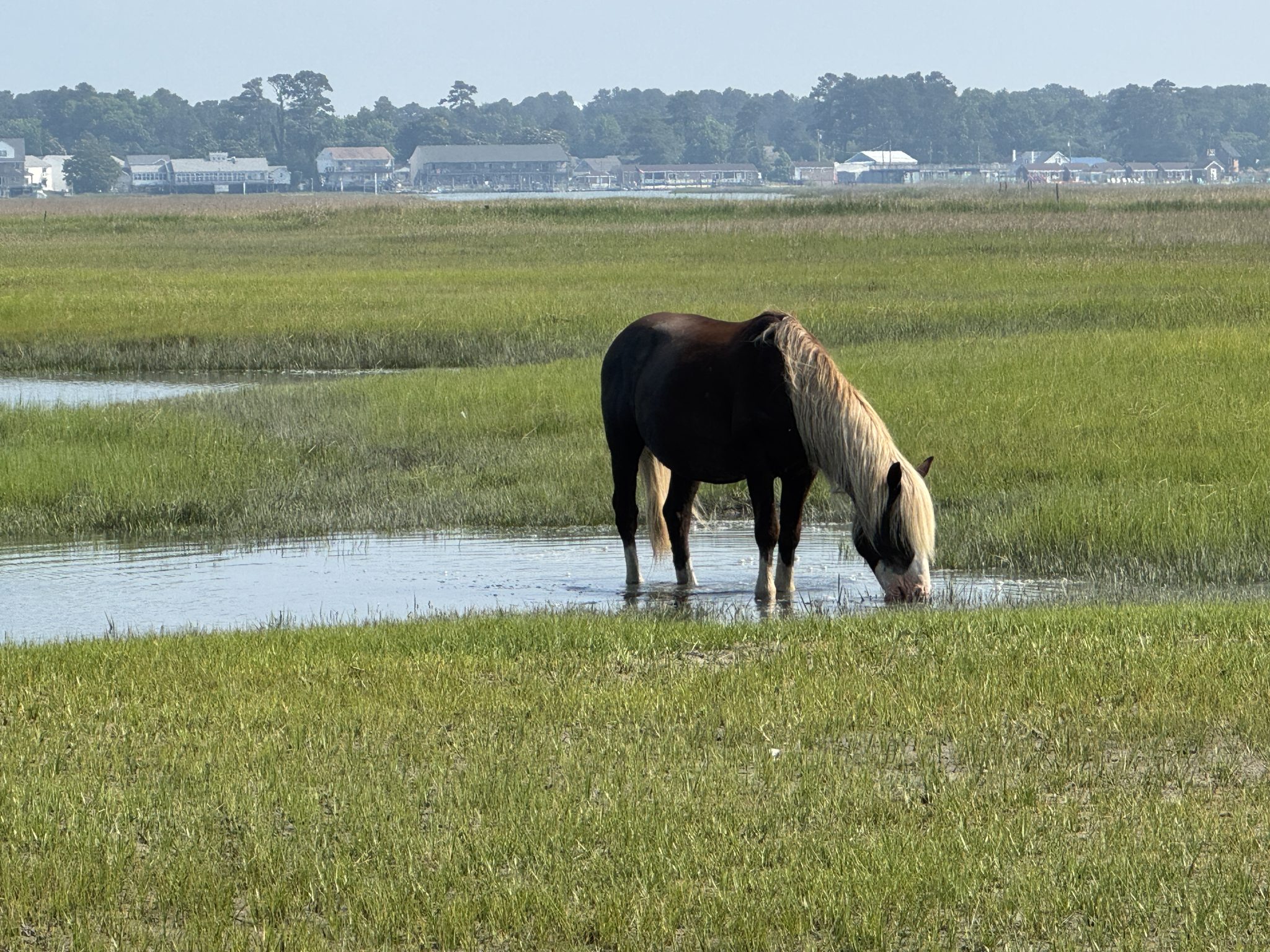
For many visitors to Chincoteague, spotting Riptide on Assateague Island is something special. With his distinctive markings and unmistakable presence, Surfer’s Riptide has become one of the best-known wild stallions in the Chincoteague pony herd.
But Riptide’s story is bigger than one famous stallion.
Since his birth on Assateague Island in 2009, Riptide has fathered numerous foals, passing his bloodline and genetics into a new generation of Chincoteague ponies. Some remained connected to the wild herd, while others left Assateague through the annual Pony Auction and began entirely different lives.
Today, Riptide’s descendants are part of the continuing story of the wild Chincoteague ponies of Assateague Island.
Who Is Surfer’s Riptide?
Surfer’s Riptide was born on Assateague Island on May 3, 2009. His sire was Surfer Dude, another well-known Assateague stallion, and his dam was Surf Queen.
Riptide is a flaxen chestnut with distinctive white facial and leg markings. Those markings aren’t simply random. Riptide carries the Splashed White 1, or SW1, gene, which contributes to the bold white markings for which he is known.
His appearance, personality and long presence on Assateague have made him a favorite among pony watchers and photographers.
If you’re new to his story, start with our complete profile:
Riptide: The Bold & Beloved Stallion of Chincoteague Island
Then come back here, because Riptide’s family tree may be just as interesting as the stallion himself.
Riptide Has Fathered a Remarkable Number of Foals
One reason Riptide has become so important to the modern Chincoteague herd is his longevity as a breeding stallion.
A stallion that successfully maintains bands of mares over many breeding seasons can leave a significant genetic footprint on the herd.
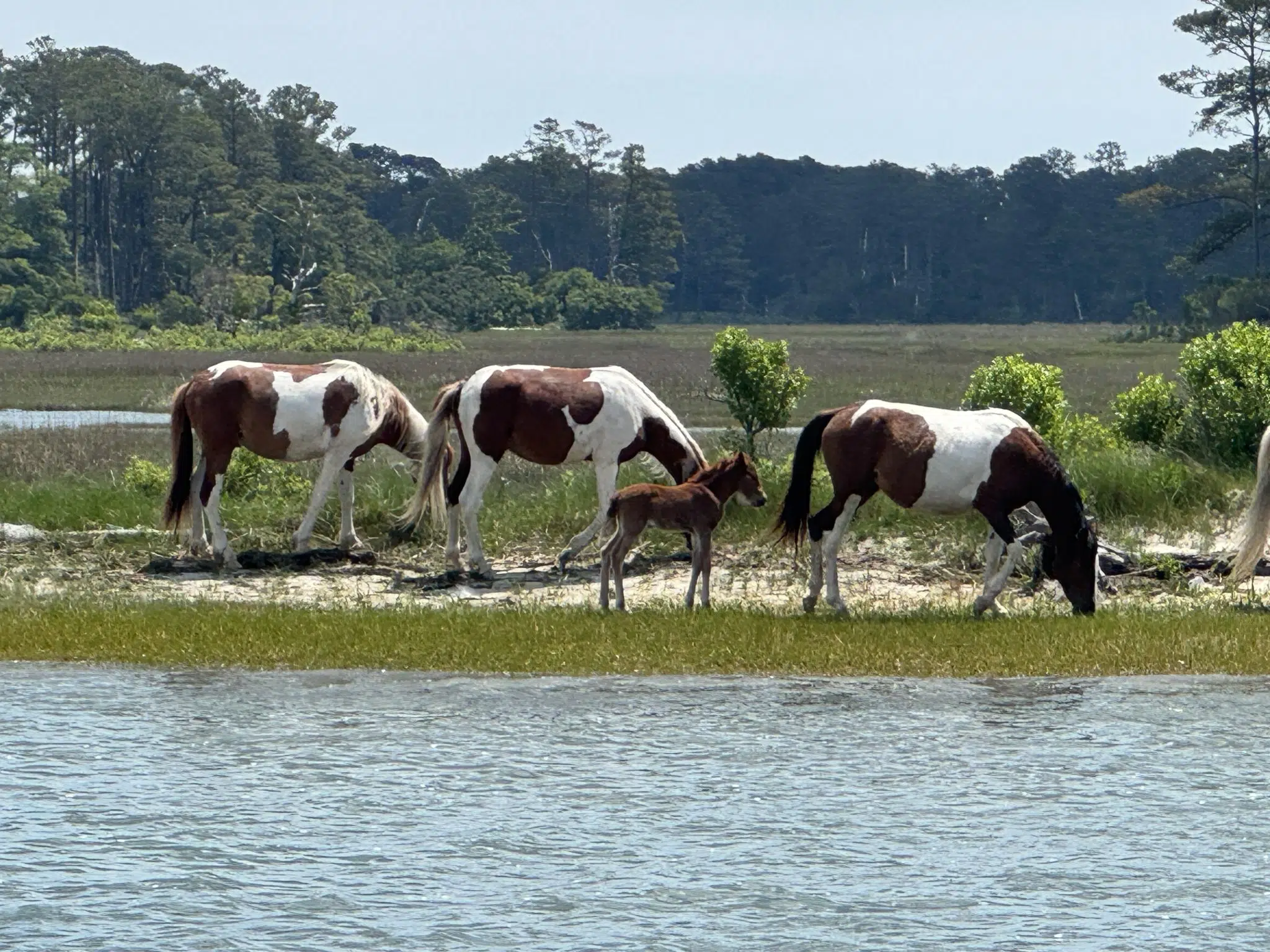
Riptide has fathered numerous documented foals during his years on Assateague. His offspring have displayed a wide variety of colors and markings, including chestnut, black, bay, palomino and pinto patterns.
Among documented Riptide offspring are ponies with memorable names such as:
- Riptide’s Sweet Ruby
- Lady of the Tides
- Kelley’s Virginia SeaGlass
- Red Skies of Assateague
- Riptide’s Ray of Sunshine
- Riptide’s Rouge Wave
- Judy’s Little Smooch
- Anne Bonny’s Faithful Warrior
- Riptide’s White Lightning
- Pappys Rio
And those represent only part of Riptide’s story.
Riptide’s Ray of Sunshine
One particularly memorable Riptide offspring is Riptide’s Ray of Sunshine, born in 2017.
Her dam was Alice’s Sandcastle, making her family tree an interesting combination of two recognizable Chincoteague pony lines.
Her palomino coloring also demonstrates something fascinating about pony genetics: Riptide’s offspring don’t necessarily look like Riptide.
The genetic contribution of both parents can produce dramatically different colors and markings from one foal to another.
Riptide’s White Lightning
Another striking descendant is Riptide’s White Lightning, born on Assateague in 2022.
She is a chestnut tobiano splashed-white mare with extensive white coloring and two different-colored eyes, one blue and one brown.
White Lightning later left Assateague through the annual Chincoteague Pony Auction.
Ponies like White Lightning provide a visible example of how characteristics can move through generations of the Chincoteague herd.
Pappys Rio
Riptide continued fathering foals well into his life.
Pappys Rio, a bay colt born in 2024, lists Surfer’s Riptide as his sire.
That means visitors seeing younger ponies on Assateague today may literally be looking at the next generation of a stallion born more than 15 years ago.
That’s part of what makes following individual Chincoteague ponies so fascinating.
You aren’t simply watching horses.
You’re watching generations.
Why Don’t All of Riptide’s Foals Stay on Assateague?
This is one of the most common questions visitors have about the Chincoteague ponies.
Each summer, the Virginia herd is rounded up for the famous Chincoteague Pony Swim and Pony Auction. Some foals are sold at auction, while selected ponies remain connected to the wild herd.
The auction is part of the long-running management of the Virginia herd and also helps support the Chincoteague Volunteer Fire Company.
As a result, Riptide’s descendants can end up following very different paths.
Some continue their lives as part of the Assateague herd.
Others leave the island and live with private owners elsewhere in the United States.
That means Riptide’s family tree extends far beyond Chincoteague.
Can You Recognize One of Riptide’s Offspring?
Sometimes, but don’t count on identifying a pony simply by its appearance.
Riptide’s recognizable markings make it tempting to assume that a similar-looking foal must be one of his descendants. Pony genetics are much more complicated than that.
His offspring can have dramatically different coats and markings depending on the mare.
That’s also why experienced pony watchers use more than color when identifying individual animals. Facial markings, stockings, body markings, age, sex, family relationships and location can all provide clues.
How Do People Know the Chincoteague Ponies’ Family Trees?
The Chincoteague pony community has an extraordinary interest in documenting individual ponies.
Over the years, dedicated observers, photographers, owners and pedigree researchers have recorded births, parentage, markings, auction information and other details.
As a result, it’s possible to trace the ancestry of many modern Chincoteague ponies back several generations.
And that’s where following one stallion like Riptide becomes particularly interesting.
A pony you see today may be connected to animals that lived on Assateague decades ago.

Riptide, Surfer Dude and a Continuing Bloodline
Riptide himself represents another generation in that story.
His sire, Surfer Dude, was already an important Assateague stallion. Riptide then went on to establish a legacy of his own.
Now Riptide’s descendants are carrying that family tree forward.
Think about that for a moment.
When you’re looking across the marsh at a band of Chincoteague ponies, you’re not just seeing today’s herd.
You’re looking at a living family tree.
Are Any Chincoteague Ponies Descendants of Misty?
This question comes up constantly because Misty of Chincoteague remains the most famous pony associated with the island.
Misty became internationally famous after Marguerite Henry’s 1947 novel Misty of Chincoteague, and her story introduced generations of children to Chincoteague and the annual Pony Swim.
There are documented Misty descendants within the broader Chincoteague pony bloodlines.
Understanding those family connections is one reason pedigree research surrounding the herd has become so popular.
Learn more about Misty and why she remains such an important part of the island’s story in our guide to what Chincoteague is famous for.
Where Can You See Riptide and His Descendants?
The Chincoteague ponies live wild on the Virginia portion of Assateague Island.
Visitors can sometimes see them from designated areas within the Chincoteague National Wildlife Refuge, but where individual bands are located changes constantly.
The ponies are wild and roam freely.
That’s also one of the advantages of seeing Assateague from the water.
On a Chincoteague wild pony boat tour, you get an entirely different perspective of the marshes, coves and shoreline where the ponies spend their lives.
No particular pony sighting can ever be guaranteed. The ponies decide where they’re going to be, and every trip is different.
That’s part of what makes seeing them so memorable.
Seeing the Ponies Is Different When You Know Their Stories
Seeing a group of wild ponies grazing across the marsh is beautiful by itself.
Knowing who you’re looking at changes the experience.
Suddenly you’re wondering:
- Is that Riptide?
- Is that one of his offspring?
- Which stallion controls that band?
- Is that mare pregnant?
- Is that foal related to one we saw last year?
That’s one reason our Barnacle Bill’s Wild Pony Boat Tour is about more than simply taking a boat ride searching for ponies.
Our tours are live-narrated and combine the wild ponies with the stories, history and wildlife of Chincoteague and Assateague Islands. Every trip is unique because the ponies and wildlife are constantly moving.
Along the way, you may see wild ponies along the shoreline, bald eagles overhead, coastal birds throughout the marsh and dolphins during their seasonal visits to the waters around Chincoteague.
Guests can also explore our exclusive Barnacle Bill’s picture book featuring hundreds of photographs that help tell the story of the ponies, wildlife and history of the islands.
Riptide’s Real Legacy
Someday Riptide will no longer be one of the stallions visitors hope to find across the marsh.
But his story won’t disappear.
It will continue through his offspring, their offspring and the generations of Chincoteague ponies that follow them.
That’s perhaps the most remarkable thing about learning the names and histories of these animals.
A wild pony standing quietly on Assateague isn’t simply another pony.
It’s another chapter in a story that has been unfolding on these islands for generations.
And Riptide has written quite a chapter.
Frequently Asked Questions About Riptide and His Offspring
How old is Riptide the Chincoteague pony?
Surfer’s Riptide was born May 3, 2009, on Assateague Island.
Who are Riptide’s parents?
Riptide’s sire is Surfer Dude and his dam is Surf Queen.
Does Riptide have offspring?
Yes. Riptide has fathered numerous documented foals during his years as a stallion on Assateague Island.
Do all of Riptide’s foals live wild on Assateague?
No. Some Chincoteague foals leave the island through the annual Pony Auction, while others remain connected to the wild herd.
Do Riptide’s foals look like him?
Not necessarily. The appearance of each foal depends on genetics inherited from both Riptide and the mare. His offspring can have very different colors, markings and patterns.
Can you see Riptide on a Chincoteague boat tour?
It’s possible, but never guaranteed. The Chincoteague ponies are wild and roam freely around their habitat on Assateague Island.
What is the best way to see the Chincoteague ponies?
Visitors can look for ponies from designated areas within the Chincoteague National Wildlife Refuge or explore the waterways surrounding Assateague. A Chincoteague pony boat tour provides a different perspective of the island’s marshes, coves and shoreline.
Are there descendants of famous Chincoteague ponies still alive?
Yes. Many modern Chincoteague ponies have documented pedigrees connecting them with earlier generations of the herd.
Want to learn more about the wild ponies? Visit our guide to seeing the wild ponies in Chincoteague or read the complete story of Riptide, one of Chincoteague’s most beloved stallions.